
Michael Pederson
TO THE HESITATING PURCHASER . . .
This is a novel about a struggling journalist (Firth) who travels to Scotland’s most northerly island, Muckle Flugga (home to the Stevenson Lighthouse of the same name) to paint a picture of a seabird as a promise to his dead father. Firth’s colourful arrival on the island, complete with an old sewing machine case for a suitcase, reminded me of The Tourist arriving in Ankh-Morpork at the beginning of Terry Pratchett’s Discworld series, and Muckle Flugga turned out to be more fantastical than any study of island life or relationships I had been expecting.
Before even setting foot on the island, Firth becomes infatuated with The Son, son of the lighthouse keeper, and attracts the immediate disdain of the lighthouse keeper, The Father of The Son. Thus Firth begins his campaign to take The Son off the island to Edinburgh, away from The Father, who seems as violent as Sunset Song’s John Guthrie, complete with suggestions of past beatings.
The Son is artistically and intellectually gifted and has Robert Louis Stevenson (of the famed family of lighthouse engineers) for an imaginary friend. There are many references to RLS’s work in this book, as well as parallels that can be drawn with his life. An example of this intertextuality is the Jekyll and Hyde nature of The Father, suffering from grief after the loss of The Mother, and also similarities with RLS’s own life: Stevenson moves to a faraway island to heal. But Firth is no Tusitala as is revealed.
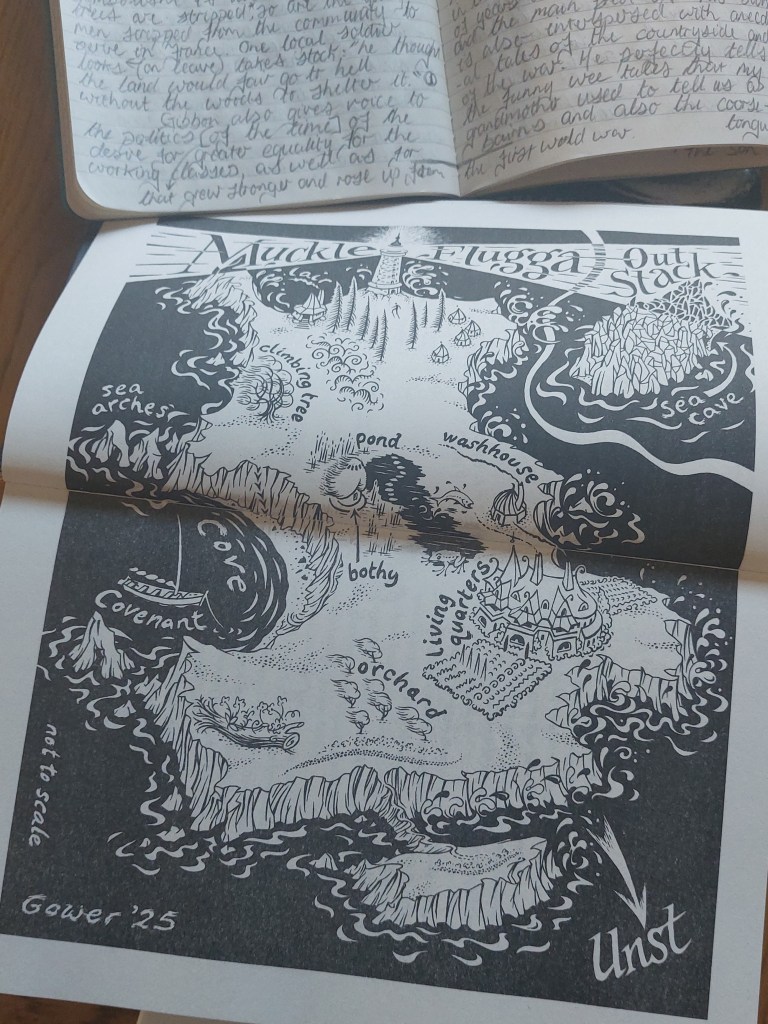
The author has stressed in interview that his version of Muckle Flugga is a fluid work of imagination, but it left me wondering why I was reading about orchards and fishponds on a North Atlantic rock. I am able to suspend belief of course, but this just makes the setting seem inauthentic. Why not create a fictional island? Also detracting from the authenticity (and therefor immersion in the story) is Pederson’s choice of language. He gives The Father a working-class Edinburgh vernacular when he is stated as hailing from the wreck-harvesting people of the Northwest coast of Scotland, and one resident of nearby Unst sounds like a Glaswegian ned from a naughties BBC Scotland sketch show. Again, I know this is fiction, but Pederson has chosen to set his novel in a factual location. I deliberately mentioned Sunset Song earlier in this review as Lewis Grassic Gibbon and Neil M. Gunn’s names have been banded about in reviews. Both those writers wrote fiction that was true to the land and gave a genuine voice to the people of the time. Muckle Flugga is not a realist study of the Scottish psyche, as is Sunset Song, Old Art and Young Hector.
Instead, Muckle Flugga is a fantastical novel, more resembling an Alasdair Gray novel than any Scottish Renaissance works. Like Gray, Pederson is not solely a writer of prose; he is also a poet, and, at the time of publication, Edinburgh’s Makar. This is evident in many places, as the prose is often beautiful and lyrical, but equally apparent in that it was sometimes prone to dwell on certain scenes and emotions, causing the pace of the prose to stall. That this is a fantastical novel is also supported by the sudden appearance (and disappearance) of an emu in a cave. His plot is also just as unsettling as anything of Gray’s complete with a man of the world attempting to lure a younger boy away from his home under false pretences by promising him the world, patronising him and covertly destroying everything he loves. Another similarity with Gray is that he seemingly draws on Mary Shelly’s Frankenstein (1818): like the tortured Victor, so does Pederson’s protagonist flee to Scotland’s Northern Isles, and Firth also emulates the words of Frankenstein’s creature in the closing pages, in what can be seen as a common manifestation of depression, by destroying something that he loves.
“Oh, Frankenstein! Generous and self-devoted being. […] I, who irretrievably destroyed thee by destroying all thou lovedst.”
AND LAST . . .
I too have loved RLS since childhood, and I have to say that I love a map at the beginning of a book, but unfortunately Pederson’s map of Muckle Flugga didn’t lead me to any treasure. I picked up some gold doubloons along the way, but that infernal voice of Captain Flint kept on squawking in my ear.
 Iain Mac Lachlainn
Leave a comment