
Neil M. Gunn
“It’s a long way when you’re looking forward, but not so long when you’re looking back.”
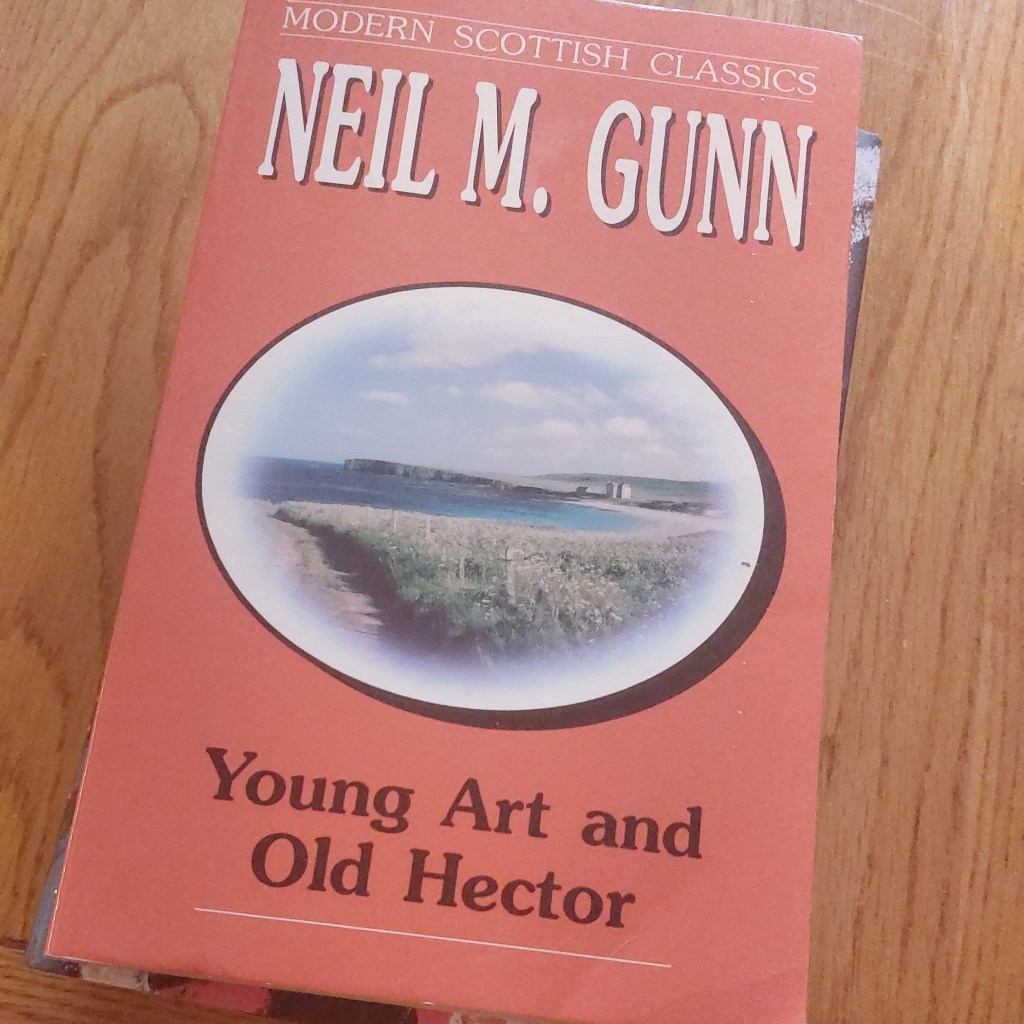
This is a novel about family, friends, home and the relationships that make those things valuable, particularly the wisdom shared between the titular characters.
The book is written in the third person, using plain and simple prose, mainly from the point of view of Young Art, an 8-year-old boy. The chapters are episodic, often interspersed with tales both mythical and historical with an overall connecting story arc. The sub-stories are usually delivered by Old Hector in his role as a Gaelic Seanchaidh (story-teller and historian in the oral tradition) within the community. It is revealed early on that as a young boy, Hector and his community were evicted from their land of many centuries, their homes torn down before their eyes, so that the so called land-owners could make a greater profit from farming sheep on the land. (For an excellent history on this, see ‘The Highland Clearances, John Prebble, 1963). Although written in English, it is made clear that the characters talk in Scottish Gaelic, and Gunn’s masterful use of sentence structure, cadence and choice of vocabulary meant that I was virtually able to hear the lilt of the Highland tongue.
“To gain possessions and have great power […]. And then people are set upon and driven from their homes, and they die in want and in suffering. At the core of that […] there is only one thing, and its name is cruelty.”
One of the main themes is that sometimes the good things in life can be sad. For instance a brother or son leaving home to go to university or to take up employment is naturally a time of pride and celebration but it is also the end of a chapter. It is a loss of the innocence of spontaneity and timelessness; you will meet again, but always in the future that precious time will be measured.
Hector has wisdom and knowledge of the land to impart in his relationship with Art, but he also learns about the young which he is seeing for the first time from an old man’s perspective. He also has much to say within the community about the obscenity of land ownership, and the inexorable link between money and greed.
“It’s when the greed of money-making started that the lairds got their charters, through laws made by lairds, and cleared our folk off the land. It was money-making they were after. And whenever the prime concern in life is money-making, then you have trickery and brutality and wrong.”
With no hope of fighting the British military or legal system, the community gain some form of resistance by poaching and operating underground whisky stills on the land that was once theirs. Carrying with it the risk of lengthy imprisonment, Gunn injects plenty of drama into the novel. These ancient practices have been outlawed by the authorities, and Hector, holding the position within the community as he does, becomes a target for interrogation by the authorities. ‘The Gaugers’, excisemen who are sent to hunt down illicit stills and arrest those producing the whisky, are often recruited from within the communities. This is a narrative which is sadly often repeated in Scottish history. The other underground insurrection is the knowledge that you hold in your mind and the courage that you hold in your heart. The rabbits and pheasants from the forests are for the stew, the salmon taken from the rivers is likewise for the table, and the whisky is for weddings and celebrations. It is for their community, and none of it is for selling, not for profit nor for making someone else rich.
These are hard-hitting themes central to the circumstances surrounding this Highland community that has been subject to the brutal ethnic cleansing and genocide carried out by the entitled classes with the support of the British Government. These people were forced to become like beggars and criminals on their own land.
But they hold on and they toil and they hope. Not for money or power, but for the peace to live and sustain themselves and to pass on their stories and traditions and to find happiness in living. The genius of Gunn’s writing is that he is able to express in words that which is the most difficult to articulate; the things that are felt in the soul:
“The house knew it. The land outside was aware of it. The mouth of the night was darker with it, and a small wind issuing forth whispered it round the edge of the thatch.”
 Iain Mac Lachlainn
Leave a comment