
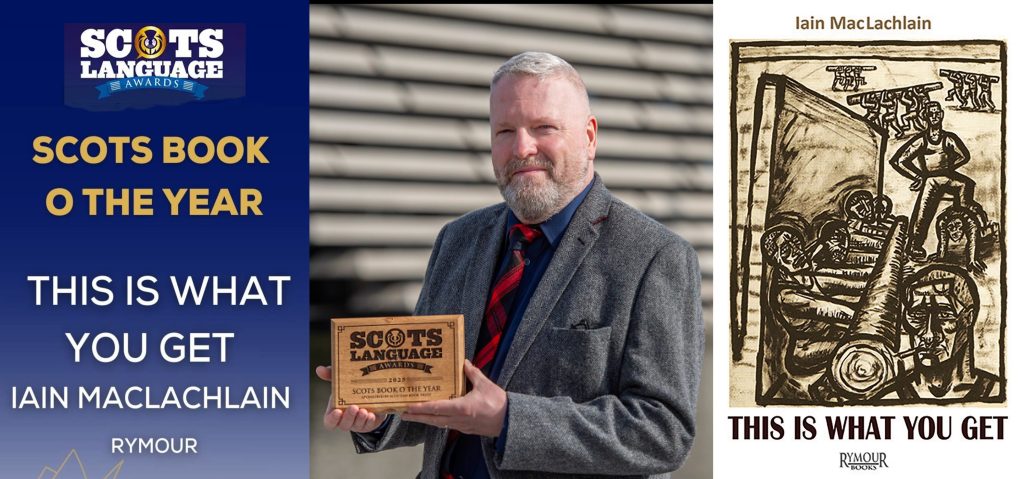
‘This Is What You Get’ was named Scots Book o the Year 2025, at a ceremony in Dundee on the 6th of September
It has been said that Scots looks ‘strange on the page’, being a predominantly spoken language.
“To be able to unashamedly produce serious work in ma ain tongue gies me an immense amount o pride.”
Despite being short-listed for the Penguin/RH WriteNow programme and praised by a London editor for its refreshing dialect, my agent couldn’t place this novel through traditional channels. Frustratingly, the general feedback was that the dialect limited the readership. It was pointed out that the only way forward for this novel was to ‘translate’ it into standard English. Being a story about young Scottish soldiers in a Scots infantry regiment, I felt that the book would lose its authenticity.
Thankfully, the then incumbent Scots Scriever, Shane Strachan, encouraged me to submit my novel to Rymour Books and subsequently it was awarded the Scots Language Publication Award by The Scottish Book Trust and The Scottish Government.
Northeast Scots is the language I was brought up with and it is how my family and friends express themselves and tell stories to one another. It was how my grandparents told us poems and sang us ballads. In the workplace, most folk use Northeast Scots in everyday conversation, including those from other parts of the UK and further afield who are proud to make the Northeast of Scotland their home. To be able to unashamedly produce serious work in ma ain tongue gies me an immense amount o pride.
The Scots Language Awards was a wonderful opportunity to speak to writers and performers with shared experiences which often included the past suppression of Scots. These echoed my own memories of the angry rebuttal of Scots in the classroom that was confusing and distressing, particularly as a young child. We hadn’t even heard of ‘Scots’: It wis jist the waye wi spoke. It was therefore fantastic to speak to teachers who are enthusiastic about encouraging children to be confident and creative in expressing and communicating in their mither tongue. Wiv come a lang waye indeed fae the days fan ‘spickin the waye wi spick’ wis severely discouraged. Receiving the award in this year o the passing o The Scottish Languages Act, which finally gives Gaelic and Scots official status in Scotland, makes it so much more of an honour.
My experience is evidence that the work of Scots language champions like The Scottish Book Trust, Hands Up for Trad and the Scots Scriever is vital in providing writers and performers with the confidence to produce work in Scots, so that their hard work and talent can be showcased and enjoyed by a wider audience in Scotland and beyond.
Through their important work, Scots is becoming more commonplace and nae sae strange on the page.
‘This Is What You Get‘ is available in paperback from Rymour Books and Amazon, with an ebook version coming soon.

 Iain Mac Lachlainn
Leave a comment